
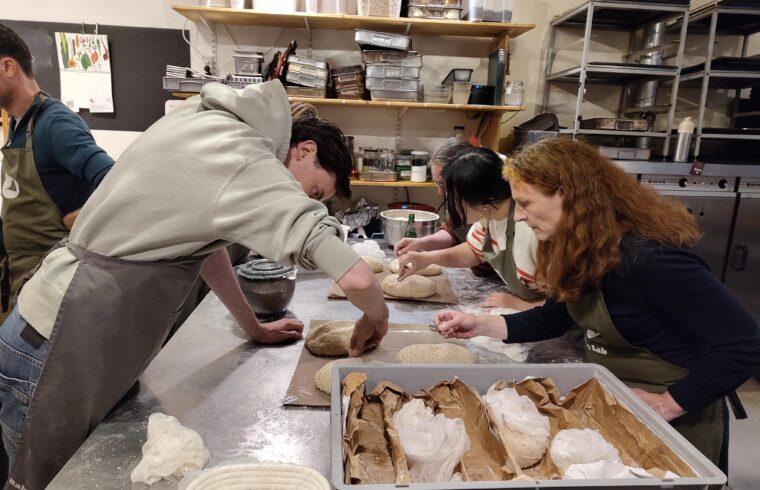
One of our bakers, Noor, is a Biomedical Sciences student doing an internship with the Molecular and Cellular Epigenetics group at the University of Amsterdam, where the big questions are explored at the molecular level: How do cells remember who they are? How do small chemical marks on DNA shape an entire organism? Outside the lab, Noor asks a different kind of question: Why does this dough feel different today? Recently, Noor brought those two worlds together by organising a bread-baking workshop at Baking Lab for her research group.
Baking bread and doing science have more in common than you might think. Both start with curiosity: How does this work? Why does this work? A recipe, like a lab protocol, is a set of instructions built on accumulated knowledge, but neither tells you what to do when something goes wrong. That’s where your senses come in. Is the dough too sticky? Does it smell right? Has it risen enough? These are not questions you answer by reading; you answer them by paying attention.
What struck Noor most was watching her colleagues. People who work with pipettes, microscopes, and sequencing data all day, suddenly slow down and feel their way through a problem. Kneading dough requires a kind of tactile reasoning that is rarely asked of us in the lab. And yet, it felt surprisingly familiar: iterating, adjusting, and trusting the process.
Working at Baking Lab has given Noor a useful perspective: the skills are more transferable than they first appear. Reading dough, adjusting hydration, and judging fermentation by smell and texture are not so different from troubleshooting an experiment. Both require you to build intuition through repetition and to know when to trust your observations.
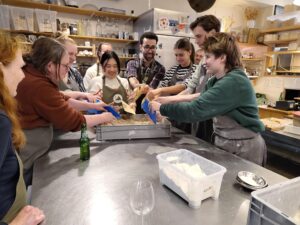
Organising this workshop was a way to test whether that intuition is teachable. It turned out that these scientists are pretty good at thinking with their hands too.